
Common Myths about Stem Cell Banking in India: Don’t Let Them Hold You Back

Expecting a baby brings a mix of feelings such as joy, anticipation and a growing sense of responsibility, prompting parents to consider choices that could support their child’s long-term health. Among these decisions, while stem cell banking often makes it to the consideration stage, many parents shy away from it due to the myths and half-truths on the subject, circulating online and within communities. Such misconceptions blur the line between real medical value of stem cell banking, leaving parents unsure of what to believe. In this article, we aim to bust common misconceptions about stem cell preservation, equipping you with the information you need to make a well-informed decision.
Common Myths about Stem Cell Banking
When it comes to stem cell banking, many parents have to navigate a mix of opinions that range from outdated beliefs and cultural biases to partial explanations of how cord blood banking contributes to long-term care. Let’s take a look at some such notions:
-
“Stem cell banking isn’t useful in real life”
This misconception often arises from evaluating stem cell banking the same way everyday medical services are evaluated - by how commonly or frequently they are used. Here, it is important to understand that stem cells do not belong in routine healthcare; rather, they deliver their promised value in critical care, which could be life-saving. That’s why it is strongly recommended for parents to go for cord blood banking, and secure a potentially life-saving medical resource for their child and family.
-
“Stem cells lose their effectiveness over time”
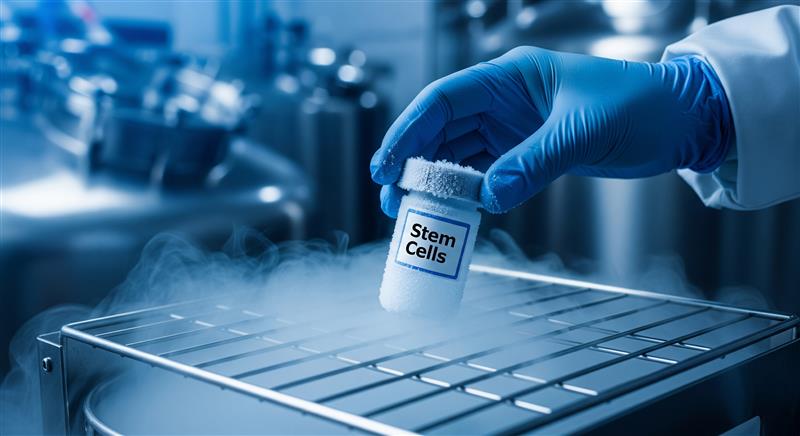
The belief that stored cells lose their effectiveness or weaken over time comes from the assumption that they are living tissues, which is simply untrue. In stem cell banking, the stem cells are stored in a controlled, cryogenic state (extremely low temperatures, typically below -150°C), which prevents aging and degradation. The long-term usability of stem cells, therefore, is not affected by the period for which they are stored; rather, the rigour with which preservation standards are maintained. In a well-managed facility, cells do not deteriorate and remain preserved exactly as they were on the day they were stored.
-
“A donor can always be found, so stem cell banking isn’t necessary”
Many families assume donor registries can always provide a timely match, but in reality, the probability of finding a fully compatible donor is quite slim. Even if a potential match exists, the process of testing, confirming availability and completing medical clearance often takes longer than what urgent treatment windows allow. In contrast, the cells stored through stem cell banking are available instantly, removing the delays and uncertainty that accompany external donor searches and ensuring that treatment is delivered in time.
-
“Stem cell banking is only beneficial for the baby, not the family”
This misconception comes from viewing preserved cells as something uniquely tied to one child, rather than a biological resource shaped by shared genetics. In reality, the value of stem cell banking extends far wider; siblings often share strong levels of compatibility, and even parents may benefit in certain situations. This makes stem cell preservation not a child-specific safeguard, but a collective asset that quietly strengthens the family’s long-term preparedness against critical illnesses.
-
“Stem cell preservation isn’t scientifically proven”
The belief that stem cell storage isn’t scientific couldn’t be further from the truth. Stem cell preservation is grounded in proven biomedical and cryogenic methods that have been standardised and refined over decades. In clinical practice, stem cells are already used in established treatments for various conditions, including many blood disorders, and certain cancers and metabolic diseases - all supported by well-defined medical protocols. While research continues to broaden the scope of future applications, the foundation on which preservation stands is recognised and clinically validated.
-
“Stem cell banking is too expensive”
This misconception often comes from seeing stem cell banking as a large, upfront medical expense rather than a structured safeguard for the future. In practice, most stem cell banks offer easy payment options such as EMIs, multi-year plans, and lifetime storage models that distribute the cost in a manageable way. What shifts the perspective is recognising that the investment is meant to secure long-term access to preserved cells, a resource that can hold far greater value than its initial price, especially when compared to the potential expense and urgency of alternative medical solutions.
Related: Stem Cell Preservation Cost in India: Everything You Need to Know
How these Myths Impact Real Decision-Making for New Parents
Misconceptions don’t just distort understanding; they reshape how parents weigh responsibility, cost and long-term security. Within the landscape of stem cell banking in India, these beliefs often redirect choices toward short-term comfort instead of future preparedness. How these myths influence emotional, financial and future-planning decisions:
- Emotional Overcaution: Myths make protective decisions feel excessive, causing parents to step back when instinct might otherwise guide them forward.
- Financial Misjudgment: Perceived high costs overshadow the long-term value of preserving a one-time biological resource.
- Short-Term Prioritisation: Immediate expenses take precedence over future medical flexibility simply because those future needs feel distant.
- Influence of Familiar Voices: Parents lean toward advice that feels emotionally safe, even when it lacks medical grounding.
- Fear of Future Regret: Myths create a false sense of safety in choosing inaction, framing “not deciding” as the safer path.
Related: Stem Cell Preservation: Why It Matters and How It Works
How Cryoviva Stands Out Among Stem Cell Banks in India
At Cryoviva Life Sciences, we combine scientific excellence, operational scale and demonstrable outcomes to offer parents a level of assurance rarely seen in the field of stem cell banking in India. The following features reflect the depth of our commitment and why we are trusted by more than 3.5 lakh families:
- Global and National Accreditation: Our processes adhere to AABB, CAP, NABL, ISO 9001:2015, WHO GMP and GLP standards, ensuring that every stage of collection, processing and storage follows internationally recognised quality protocols.
- Comprehensive Mother-and-Child Ecosystem: Our services cover cord blood and tissue banking, bone marrow and peripheral blood stem cell harvesting, and predictive genomics, creating an integrated pathway for long-term mother-and-child care.
- Private and Social Banking Options: Cryoviva provides both private and social banking models, giving families choice and flexibility while expanding access to a broader pool of matched units when needed.
- Transparent Technology and Process Excellence: We use advanced methods such as closed-bag collection and precision-driven processing systems that help reduce contamination risk and support transplant-ready quality standards.
- Flexible and Transparent Plan Options: Cryoviva offers a range of accessible plans, including zero-interest EMIs and long-term storage choices, supported by clear pricing and no hidden charges. This approach ensures families can choose stem cell preservation with greater confidence and financial ease.
- High-End Infrastructure: Cryoviva operates a 28,000 sq ft, state-of-the-art processing and banking facility in Gurugram, built to support large-scale operations with precision, consistency and long-term reliability for families across India.
- Proven Clinical Utility: Our record includes documented sample releases for treatment and successful transplant support, demonstrating that our role extends beyond storage to meaningful clinical outcomes when required.
- Pan-India Reach and Multinational Support: With presence in more than 250 cities and the backing of the RJ Corp group, Cryoviva offers a blend of national accessibility and multinational stability, reinforcing its position as a trusted stem cell bank in India.
Start Your Stem Cell Banking Journey with Cryoviva Life Sciences
Choosing whether to preserve your baby’s stem cells is ultimately a decision about safeguarding possibilities that do not yet exist but may one day matter profoundly. As medical science continues to evolve, stem cell preservation represents a rare moment in parenthood where a single choice can create long-term biological security for the entire family. Cryoviva Life Sciences integrates accredited processes and advanced technology within a framework that has made it a trusted name in stem cell banking in India, helping parents make this decision with clarity and confidence. If you would like to understand the process, explore plans or simply clarify your options, you can reach us at 1800 101 9587 or fill out the contact form on our website. You may also connect with us at support@cryovivalifesciences.in or subscribe to our newsletter to stay informed as new advancements unfold.
Frequently Asked Questions
Q. What is stem cell banking and how does it work?
Stem cell banking involves collecting and storing stem cells, usually at birth, so they can be preserved for possible future medical use under controlled conditions.
Q. How long does stem cell preservation remain effective?
When stored through advanced cryogenic methods, stem cell preservation can remain viable for decades as long as the temperature and monitoring systems remain stable.
Q. Is cord blood banking useful only for the baby?
No. Cord blood banking may also support siblings and, in some cases, parents, depending on genetic compatibility and medical requirements.
Q. If I am considering stem cell banking in India, when should I register?
Registration should be completed before delivery, because cord blood or tissue can only be collected immediately after birth.
Q. Is cord blood banking safe for the mother and baby during delivery?
Yes. The process of cord blood banking is performed only after the baby is born and the umbilical cord is clamped, making it safe for both the mother and newborn.
Q. Can I use cord blood banking in India if I have a high-risk pregnancy?
Yes. Parents with high-risk pregnancies can opt for cord blood banking in India as long as collection is arranged in advance and carried out by an experienced clinical team.
Q. How can I find a reliable stem cell bank in India?
A trustworthy stem cell bank in India should have strong accreditations, advanced processing standards and a proven record of safe, long-term storage. Cryoviva Life Sciences meets these criteria through globally aligned processes and nationwide support.



 Enquiry
 Email
Email Phone
Phone
 Whatsapp