
Exosome therapy is an emerging area in regenerative medicine that utilises nano-sized vesicles derived from mesenchymal stem cells, particularly those sourced from umbilical cord tissue. These vesicles carry essential proteins, lipids, and genetic material and have shown potential to support tissue repair, regulate inflammation, and aid regenerative processes.
At Cryoviva Life Sciences, we have specialised facilities to carefully collect, process and preserve Mesenchymal stem cells under the globally-recognised standards laid out by authorities such as WHO, ISO, FDA, and CAP. This ensures that the stem cells retain their biological integrity and long-term viability, allowing them to remain a valuable resource for generating therapeutically relevant exosomes whenever needed.
What is Exosome Therapy?
Exosome therapy is a cell-free approach in regenerative medicine. Instead of introducing live stem cells into the body, this therapy uses the signalling vesicles produced by those cells. These vesicles carry biological instructions that support repair and regeneration, without the complexities associated with transplanting living cells.
Once administered, exosomes interact with nearby cells by delivering microRNA and other signalling molecules. This process helps regulate inflammation, supports tissue repair, and promotes healing in damaged areas. The response develops gradually, and in many cases, noticeable changes may be observed over a period of several weeks to a few months.
Exosome therapy offers a cell-free alternative in regenerative medicine. Rather than transplanting live stem cells—with their associated complexities—this approach leverages the extracellular vesicles (exosomes) those cells naturally produce. These nano-sized vesicles act as messengers, carrying biological instructions like microRNA and proteins to orchestrate repair and regeneration.
Upon administration, exosomes fuse with target cells, delivering their cargo to modulate inflammation, stimulate tissue repair, and accelerate healing in damaged areas. Effects typically emerge gradually, with noticeable improvements often appearing over several weeks to months.
Exosomes vs. Stem Cells: Understanding the Difference
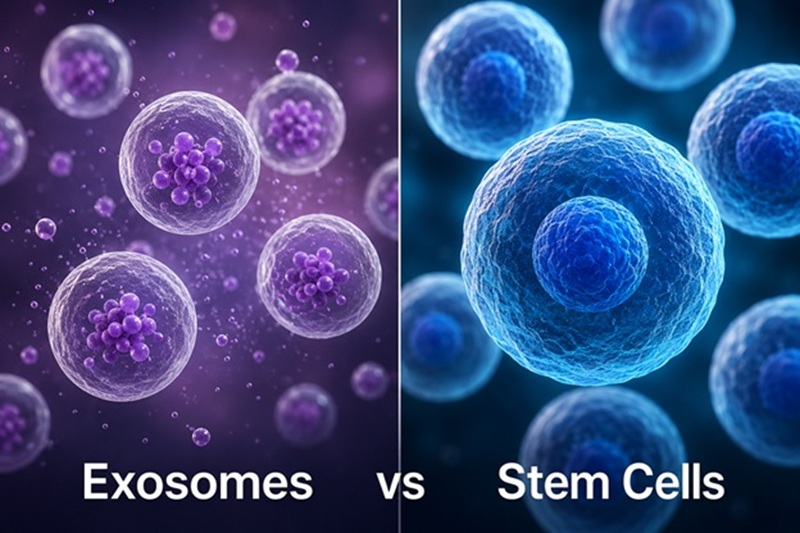
|
Aspect |
Stem Cell Therapy |
Exosome Therapy |
|
Therapeutic Agent |
Living stem cells |
Cell-derived extracellular vesicles |
|
Immunogenicity Risk |
Variable (low in autologous, higher in allogeneic use) |
Generally lower, but not absent |
|
Replication Capacity |
Present — cells can proliferate |
Absent — non-replicative |
|
Stability & Logistics |
Complex handling to maintain cell viability |
More stable and easier to store/transport |
|
Mechanism of Action |
Combination of differentiation and paracrine signaling |
Primarily paracrine signaling and molecular communication |
|
Clinical Status |
Established for specific uses (e.g., hematopoietic transplants) |
Mostly investigational, with ongoing clinical studies |
Where Do Therapeutic Exosomes Come From?
Not all exosomes carry the same therapeutic value. Their biological activity depends entirely on the cell that produces them.
In clinical and research settings, the most studied and effective exosomes are those derived from mesenchymal stem cells. MSC-derived exosomes carry the regenerative and immunomodulatory properties of the parent cell, including tissue repair signals, anti-inflammatory factors, and growth-promoting microRNAs, making them the most relevant source for therapeutic applications.
Why the Quality of Stored MSCs Matters
The effectiveness of exosome therapy does not begin in the clinic. It begins at the point where MSCs are preserved.
- Poorly processed or inadequately stored MSCs lose biological strength over time
- Weakened cells produce exosomes with diminished signalling capacity
- MSCs preserved under validated cryogenic conditions retain their full functional integrity
- Well-preserved cells produce exosomes carrying the complete regenerative payload needed for clinical application
This is where Cryoviva Life Sciences plays a defining role. Every mesenchymal stem cell processed and stored at our GMP-certified facility undergoes rigorous quality assessment for viability, purity, and safety before entering long-term cryogenic storage. The result is a biological resource that retains its therapeutic potential not just today, but for years and decades to come.
Why the Quality of Stored Stem Cells Matters
The success of exosome-based applications is determined long before clinical use—it begins at the point of stem cell preservation.
- Inadequate processing or storage conditions can compromise cell viability, identity, and functional performance over time
- Variations in cell quality can directly influence the consistency and bioactivity of derived exosomes
- Cells preserved under validated cryogenic protocols retain critical biological attributes within tightly controlled quality parameters
- High-quality preserved cells enable the generation of exosomes with robust and reproducible signaling profiles
This is where Cryoviva Life Sciences sets itself apart. Every stem cell sample processed and stored in our GMP-certified facility is subjected to comprehensive quality evaluation—including viability, purity, identity, and sterility—prior to long-term cryogenic preservation.
Backed by stringent process controls and globally benchmarked standards, we deliver a secure, traceable, and quality-assured biological resource—engineered to support future regenerative applications with consistency, reliability, and confidence over extended storage durations.
Conditions Being Studied Under Exosome Therapy
Exosome therapy is currently being explored across multiple medical specialities. The wide range of conditions under investigation reflects the ability of mesenchymal stem cell-derived exosomes to influence inflammation, repair processes, and cellular communication.
Orthopaedic and Musculoskeletal Conditions
Research in this domain is exploring the role of exosomes in supporting cartilage homeostasis, modulating inflammatory pathways, and enhancing tissue repair processes. Through their bioactive cargo—including proteins, lipids, and regulatory RNAs—exosomes may influence cellular communication and contribute to regenerative responses within musculoskeletal tissues.
Conditions currently under investigation include:
- Osteoarthritis
- Degenerative disc disease
- Sports-related musculoskeletal injuries
- Rheumatoid arthritis
- Spinal cord injuries
Neurological Conditions
Exosomes are being studied for their potential to support nerve repair and reduce neuroinflammation. Their ability to cross certain biological barriers has made them a subject of interest in neurological research.
Conditions being explored include:
- Parkinson’s disease
- Alzheimer’s disease
- Cerebral palsy
- Multiple sclerosis
- Stroke
- Amyotrophic lateral sclerosis (ALS)
Cardiovascular Conditions
In cardiovascular research, exosomes are being investigated for their potential role in promoting angiogenesis, modulating inflammatory responses, and supporting myocardial tissue repair. Through the transfer of bioactive molecules, they may influence cellular signaling pathways involved in vascular regeneration and cardiac recovery.
Areas of investigation include:
- Ischaemic heart disease
- Heart failure
Inflammatory and Autoimmune Conditions
The immunomodulatory properties of MSC-derived exosomes make them relevant in conditions driven by chronic inflammation and immune system dysregulation.
Conditions under study include:
- Lupus
- Inflammatory bowel disease
- Pulmonary fibrosis
- Chronic autoimmune disorders
Dermatological and Ageing Applications
Exosomes are increasingly being explored in regenerative dermatology for their potential role in modulating skin repair, supporting extracellular matrix remodeling, and enhancing overall skin quality. Through the delivery of bioactive molecules, they may influence cellular processes such as collagen synthesis, pigmentation regulation, and tissue regeneration.
Applications under investigation include:
- Scar remodeling
- Pigmentation disorders and correction
- Skin regeneration and repair
- Ageing and aesthetic skin rejuvenation
Other Conditions Under Active Investigation
Ongoing research is also evaluating exosome-based approaches across a broad range of therapeutic areas, with a focus on their potential to modulate inflammation, cellular signaling, and tissue repair processes.
Areas of investigation include:
- Diabetes and associated complications
- Renal (kidney) disorders
- Hepatic (liver) diseases
- Ophthalmic conditions, including optic nerve atrophy and retinopathy (early-stage research)
- Reproductive health and infertility (primarily preclinical and early clinical research)
Cryoviva's Role in Exosome Therapy
The foundation of exosome therapy begins much earlier than the point of treatment. It starts with how mesenchymal stem cells are sourced, processed, and preserved, which is where Cryoviva Life Sciences plays a critical role.
With over 3.5 lakh families served, a presence across 250 cities, and 36 samples released for potential therapeutic applications, Cryoviva brings proven experience to every stage of stem cell preservation. The facility operates in alignment with globally recognised quality and laboratory standards, including ISO certifications and CAP-accredited protocols, ensuring that every mesenchymal stem cell is handled with consistency, safety, and precision from collection through long-term cryogenic storage.
In 2026, Cryoviva Life Sciences was recognised as the Most Promising Company in Genomic Science and Regenerative Medicine at the 16th MT India Healthcare Awards. This recognition reflects its continued commitment to advancing biobanking and supporting the future of regenerative medicine, including evolving areas such as exosome-based applications.
What We Do at Every Stage
- Processing: Stem cells sourced from umbilical cord tissue are processed in specialized, GMP-compliant laboratories under strictly controlled conditions, aligned with internationally recognized quality standards
- Quality Assessment: Each sample undergoes comprehensive evaluation for viability, purity, identity, and sterility before being qualified for long-term preservation
- Cryopreservation: Advanced, validated cryogenic protocols are employed to maintain cellular integrity and stability over extended storage durations, with plans ranging from 21 to 75 years
- Continuous Monitoring: Cryostorage environments are monitored 24/7 across four dedicated facilities, supported by robust backup systems, redundancy measures, and contingency protocols to ensure uninterrupted preservation
- Release Support: Upon request, Cryoviva facilitates the controlled retrieval and release of stored samples in accordance with regulatory and quality requirements—supported by a proven track record of successful sample releases
Why This Matters for Exosome Therapy
As research into exosome therapy accelerates, the quality of the MSCs preserved today determines the therapeutic value available tomorrow. Families and individuals who bank with Cryoviva are not simply storing cells for known conditions. They are preserving readiness for a category of treatment that science is actively developing — backed by an organisation recognised for its leadership in genomic science and regenerative medicine.
Why Choose Cryoviva Life Sciences for MSC
|
Cryoviva Advantage |
Details |
|
International Accreditations |
WHO, ISO, FDA, and CAP accredited - among the most recognised quality frameworks globally |
|
Proven Track Record |
36 confirmed sample releases for therapeutic use across a range of conditions |
|
Scale and Reach |
3.5 lakh families served across 250 cities in India and beyond |
|
Dedicated Infrastructure |
4 specialised storage centres with round-the-clock environmental monitoring |
|
Scientific Expertise |
350 trained staff with focused experience in stem cell banking and processing |
|
Long-Term Storage Options |
Flexible storage plans ranging from 21 to 75 years |
|
Industry Recognition |
Awarded Most Promising Company in Genomic Science and Regenerative Medicine at the 16th MT India Healthcare Awards 2026 |
The long-term potential of any stem cell-based application, including exosome therapy, depends on the quality of the cells preserved at the outset. At Cryoviva Life Sciences, every step is aligned with maintaining that standard, ensuring that stored cells remain suitable for future clinical use as the field continues to advance.
Preserve the Source. Protect the Potential.
As regenerative medicine continues to evolve, the choices made today around stem cell preservation play a defining role in shaping future treatment possibilities.
Cryoviva Life Sciences brings over a decade of focused expertise, internationally accredited infrastructure, and a proven track record of 36 successful sample releases for therapeutic use - to every cell it stores. Recognised as the Most Promising Company in Genomic Science and Regenerative Medicine at the 16th MT India Healthcare Awards 2026, Cryoviva continues to set the standard for stem cell banking in India and across the world.
The mesenchymal stem cells stored with Cryoviva today are preserved with precision, strict quality control, and globally recognised accreditations, ensuring they remain viable for emerging therapies, including those being actively explored in exosome-based research.
To learn more about stem cell preservation and storage at Cryoviva Life Sciences, call us on 1800 101 9587 (toll-free) or connect with our experts for personalised guidance
FREQUENTLY ASKED QUESTIONS
What is the difference between exosome therapy and stem cell therapy?
Stem cell therapy transplants live cells into the body. Exosome therapy uses the vesicles produced by stem cells, carrying their signalling molecules, without introducing live cells. This makes exosome therapy a cell-free alternative with a lower risk of immune rejection - though it remains investigational across most conditions.
Does Cryoviva Life Sciences administer exosome therapy?
No. Cryoviva's role is in the processing, preservation, and long-term storage of mesenchymal stem cells - the source from which therapeutic exosomes are derived. Clinical administration is carried out by treating physicians and specialist centres.
Why does the quality of stored MSCs matter for exosome therapy?
The biological activity of exosomes is directly determined by the health and potency of the MSCs that produce them. MSCs stored under validated cryogenic conditions retain the cellular integrity needed to produce clinically effective exosomes. Poorly preserved cells generate exosomes with diminished therapeutic value.
Can cord tissue stem cells serve as a source for exosome therapy?
Yes. Umbilical cord tissue is one of the richest and most accessible sources of MSCs. These neonatal cells are younger, show stronger expansion capacity, and are considered highly suitable for exosome production. Banking cord tissue at birth preserves this source for future therapeutic applications — and that collection window exists only once.
Is exosome therapy approved in India?
For therapeutic applications such as orthopaedic conditions, chronic wounds, and systemic conditions, exosomes are currently classified as investigational biologics in India and are permitted under physician oversight in line with the National Guidelines for Stem Cell and Related Product Use. Regulatory frameworks continue to evolve as the evidence base grows.
How does Cryoviva ensure stored MSCs remain suitable for future use?
Cryoviva operates four dedicated storage centres monitored round the clock, supported by 350 trained scientific staff. Every sample is processed in an internationally accredited laboratory, holding WHO, ISO, FDA, and CAP recognition, and assessed for viability and safety before entering long-term cryogenic storage. Plans ranging from 21 to 75 years ensure that preserved cells remain available across every stage of a family's life. The organisation's 36 confirmed sample releases for therapeutic use demonstrate that this preservation translates directly into clinical readiness.
 Enquiry
 Email
Email Phone
Phone
 Whatsapp